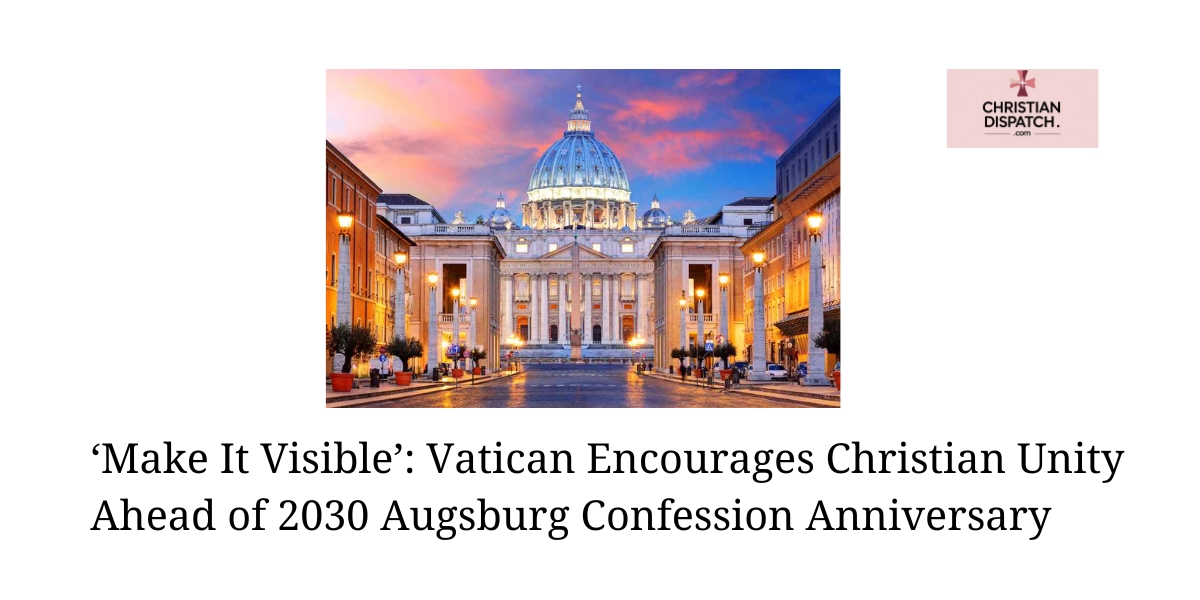
ROME — As the 500th anniversary of the Augsburg Confession approaches in 2030, senior Vatican officials are highlighting the historic Lutheran document as a potential point of shared reflection and dialogue among Christian denominations.
During the annual Week of Prayer for Christian Unity, held January 18–25, Cardinal Kurt Koch, prefect of the Vatican’s Dicastery for Promoting Christian Unity, referenced ongoing discussion about the Catholic Church’s possible recognition of the Augsburg Confession.
Writing in the Italian edition of L’Osservatore Romano, Koch noted that the document’s authors expressed “their fundamental conviction that it is a Catholic confession.” He added that, in light of this perspective, the ecumenical significance of the 1530 Diet of Augsburg should not be underestimated.
The Augsburg Confession, drafted by Philip Melanchthon and presented to Holy Roman Emperor Charles V, sought to clarify Lutheran beliefs and demonstrate continuity with the teachings of the early church. Composed in the aftermath of Martin Luther’s 1521 excommunication by Pope Leo X, the document aimed to resolve growing divisions within Western Christianity.
Archbishop Flavio Pace, secretary of the dicastery, emphasized the value of revisiting the confession as an opportunity to “rediscover a common foundation” among Christians. In comments to Vatican News, Pace described the document as an early effort to articulate shared beliefs among communities shaped by the Reformation.
Fr. Lorenzo Murrone, co-pastor of Rome’s Confessional Lutheran Church of Italy, described the confession as a significant ecumenical text, noting that its original intent was to promote understanding between emerging evangelical communities and the Roman Catholic emperor. He also pointed out that Melanchthon concluded the confession by affirming that its doctrine and ceremonies were not contrary to Scripture or the universal church.
Cardinal Koch explained that the confession’s first section affirms agreement with the doctrinal foundations of the early church, while the second addresses reforms of practices considered problematic at the time. He suggested that the Reformation, at its outset, understood itself as a movement for renewal within the broader church rather than as a break in Christian unity.
Previous popes have also reflected on the document’s historical role. At the 450th anniversary of its presentation in 1980, Pope John Paul II referred to it as “the last energetic attempt at reconciliation,” acknowledging both its aspirations and the divisions that followed.
Joseph Ratzinger likewise expressed appreciation for efforts to explore whether the Augsburg Confession could be understood in a way that affirms the catholicity of churches shaped by the Reformation, potentially supporting unity in diversity.
According to Koch, attempts in 1980 to formally recognize the confession as Catholic were ultimately unsuccessful, in part due to differing interpretations of what such “recognition” would entail.
The renewed attention to the Augsburg Confession aligns with broader ecumenical efforts under Pope Leo XIV, who has emphasized Christian unity since his election last May. In his apostolic letter Unitate Fidei, marking the 1,700th anniversary of the Council of Nicaea, Leo encouraged Christians to move beyond long-standing theological disputes and to seek common witness in faith and charity.
In October, Leo participated in a joint service in Rome with Stephen Cottrell and King Charles III, underscoring the Vatican’s ongoing engagement with Anglican leaders.
Concluding this year’s Week of Prayer for Christian Unity on Jan. 25, Leo stated: “We are one. We already are. Let us recognize it, experience it and make it visible.”
Some scholars suggest that renewed reflection on the Augsburg Confession could contribute to a stronger shared Christian witness. Jesuit scholar Fr. Bryan Lobo, a professor of missiology and former dean at Rome’s Pontifical Gregorian University, described Martin Luther as a “prophetic voice” in church history and said that acknowledging the Reformation’s contributions may strengthen mission efforts and cooperation among Christian communities.
As 2030 approaches, Vatican leaders appear to be framing the anniversary not only as a historical milestone, but also as an opportunity for continued dialogue across denominational lines.